
Postpartum hair loss? Don't panic
Why your hair sheds a few months after giving birth, how long it lasts, gentle ways to care for your hair meanwhile, and when shedding needs a doctor.
Hair in the shower drain, on your pillow and all over your baby's clothes. A few months after giving birth, many Mamas find their hair coming out in handfuls. It is alarming, it is very common, and it grows back.
Why hair falls out after birth
Each hair on your head goes through a cycle. It grows for a few years, rests for a few months, then falls out and is replaced by a new one. Normally only a small share of your hair is resting at any one time, so you shed a modest amount every day without noticing.
During pregnancy, high oestrogen levels keep more hairs in the growing phase for longer. That is why many women find their hair thicker and glossier while pregnant. After the birth, hormone levels drop quickly. A large group of hairs moves into the resting phase together, and a few months later they all fall out at once.
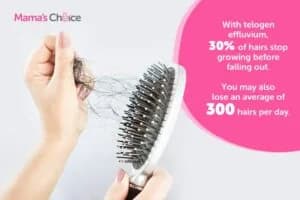
Doctors call this telogen effluvium. According to the American Osteopathic College of Dermatology, up to around 30% of hairs can switch to the resting phase, and you may lose an average of 300 hairs a day instead of the usual 100 or so. It looks like a lot because it is a lot, all at once.
How long it lasts
Shedding usually starts two to four months after the birth and is often heaviest around the fourth month. The American Academy of Dermatology says most women see their hair return to its usual fullness by their baby's first birthday.
You are not going bald. The hair you lose is the extra you kept during pregnancy, and new hairs are already growing in behind it. Many Mamas notice short, wispy new hairs along the hairline a few months later. That is a good sign.
How it differs from other hair loss
Postpartum shedding is spread across the whole scalp. You notice it most when washing or brushing, and the parting or temples may look thinner for a while. Other kinds of hair loss look different. Alopecia areata, an autoimmune condition, causes smooth, round bald patches. Hair that breaks off partway along the strand points to damage from heat or tight styles.
See your doctor if:
- you have patchy bald spots
- your scalp is red, scaly, itchy or sore
- shedding carries on well past your baby's first birthday
- you also feel very tired, cold, low or breathless, or notice weight changes
Thyroid problems and iron deficiency anaemia are both common after birth and can cause hair loss. A simple blood test checks for them, and treating them helps your hair recover.
Caring for your hair while it sheds
Nothing has been shown to stop postpartum shedding, because it is driven by hormones. What you can do is look after the hair you have and avoid breaking it.
Be gentle
- Use a wide-toothed comb and start from the ends
- Let hair air-dry when you can, and keep heat tools on a low setting
- Skip tight ponytails, buns and braids that pull at the roots, and choose soft scrunchies over rubber bands
- Pat hair dry with a towel instead of rubbing
- Wear your tudung loosely over a soft inner cap, if you cover your hair, so it does not pull
Wash as normal
Washing does not make more hair fall out. It only removes hairs that were already loose, which is why it seems worse in the shower. A mild shampoo and a conditioner on the lengths keep hair soft and easier to comb, which means less breakage.
Try a softening hair mask
A conditioning mask once a week helps hair feel smoother and less brittle. Aloe vera gel is a popular choice. Masks will not change how much hair sheds from the root. Softer hair does tangle and snap less.
Eat well
Your body is recovering from birth and, if you are breastfeeding, making milk. Regular meals with protein, iron-rich foods such as meat, beans and leafy greens, and fruit with vitamin C all help. Keep taking any supplements your doctor has recommended. Extra biotin or hair vitamins will not help unless you are actually short of something.
Consider a new cut
A shorter style or a few layers can make thinner hair look fuller and is easier to manage with a newborn.
Look after yourself too
Losing hair can knock your confidence at a time when you are already tired and adjusting to a new life. Be kind to yourself. It is temporary.
If you are feeling low most days, crying often or struggling to cope, that may be more than tiredness. Postnatal depression is common and treatable. Talk to your doctor or klinik kesihatan, or call Talian Kasih on 15999 or Befrienders KL on 03-7627 2929 for someone to talk to. If you ever have thoughts of harming yourself, call 999.
Sources
Share this article
This article is for information only and is not a substitute for diagnosis or medical advice. Please talk to your doctor about your own situation.