
How to sleep train your baby
A clear look at sleep training ages, methods and evidence, and how to make it work in a Malaysian home with grandparents and helpers around.
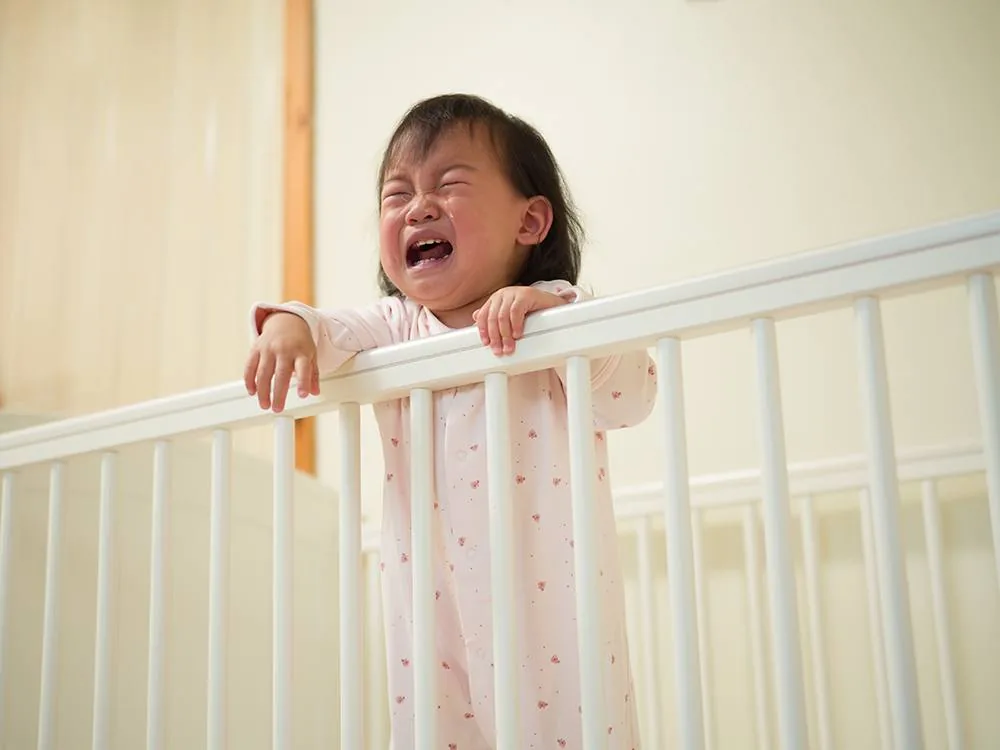
Sleep training is a set of methods for teaching a baby to fall asleep without being fed, rocked or held, usually from around four months. It is a choice for your family, never a medical requirement. The methods differ mainly in how much crying you are willing to allow, and doing nothing at all is a perfectly good option.
What sleep training actually means
The skill being taught is narrow. A baby who can fall asleep on her own at bedtime can usually settle herself again when she surfaces between sleep cycles at 1am, instead of needing the same rocking or feeding that got her to sleep in the first place.
It does not mean leaving a hungry baby. It does not mean never going in. And it does not mean she stops waking, since all babies surface during the night, just as adults do.
The NHS, in its guidance on helping your baby to sleep, puts most of its weight on a steady wind-down routine and on putting a baby down drowsy but awake. That routine sits under every named method below, and for many families it is all that is needed.
From what age is sleep training appropriate?
Four months is the usual earliest point. The American Academy of Pediatrics describes babies becoming able to sleep for longer stretches around that age, as night feeds reduce and sleep patterns mature. Before then, waking is how a newborn gets fed, and your job is to feed her.
Use corrected age if your baby was premature. Ask your doctor first if she was premature, has reflux, is not gaining weight well, or has any condition that affects her breathing or feeding.

Nothing obliges you to start at four months, or at eight, or ever. Sleep training sits alongside weaning schedules and screen rules as a family decision, shaped by what your household can keep up. A mother going back to shift work has a different calculation from one whose own mother lives with her.
Safe sleep comes first, whatever you choose
No settling method changes the safe sleep rules, and some of them matter even more once a baby is being put down awake and alone. KKM and the American Academy of Pediatrics agree on the essentials. On her back, in her own cot, on a firm, flat mattress, with no pillows, bolsters, quilts, bumpers, soft toys or loose bedding near her face.
A hanging sarong cradle or buai is not a firm, flat surface, and neither is an adult bed or a sofa. Keep the cot in your room for the first months. Before the first night of any new routine, check the cot slats, how well the mattress fits, and anything hanging within reach. Cords from blinds and curtains come down.
The main approaches, including doing nothing
Methods are usually ranked by how much crying they allow. Pick the one you can carry out every night, including at 2am when you are exhausted, because sticking with it matters more than which one you choose.
| Approach | What you do | Crying involved |
|---|---|---|
| No formal training | Feed, rock or carry her to sleep as before, and wait for her to mature | Little or none |
| Pick up, put down | Put her down awake, pick her up to calm her whenever she cries, put her down again | Low, in bursts |
| Chair or fading method | Sit beside the cot, soothe without lifting, move the chair further away every few nights | Low to moderate |
| Timed checks, often called the Ferber method | Leave the room, go back at lengthening intervals to reassure her briefly without lifting her | Moderate |
| Full extinction, or cry it out | Finish the bedtime routine, leave, and do not go back except for feeds or real need | Highest |
Doing nothing
Night waking settles with age in most children whether or not anyone steps in, and a family that is coping does not owe anyone a programme. Feeding, rocking or carrying a baby to sleep is normal across much of Asia and very common in Malaysian homes.
The cost is time and your own sleep. The benefit is no crying and no argument with whoever in the family thinks sleep training is unkind.
Pick up, put down, and the chair method
Both aim to teach the skill while you stay present. Pick up, put down is physically tiring and tends to suit younger babies. The chair method has you sit where she can see you, respond a little less each night and move the chair towards the door over a week or two. Some babies find that reassuring and others find it maddening.
Timed checks and full extinction
With timed checks, you go back into the room at intervals that get longer each night and reassure her with your voice or a hand on her back, without lifting her. Full extinction skips the checks. Both are hard on parents for the first few nights. Both need every adult at home to agree in advance, because rescuing her after 12 minutes only teaches her that crying works if it lasts 12 minutes.
What the evidence does and does not show
Be wary of numbers. Cochrane, which assesses the quality of health research, regards behavioural sleep interventions in infancy as an area where the research is limited and the findings mixed. That is why no article can reliably tell you how many nights it will take or give you a success rate.
What can be said is modest. Some families see improvement within a week or two. Others see none and stop. Teething, a cold, balik kampung or a growth spurt can all undo progress for a while, and that is normal.
Setting up the room in a Malaysian home
Space comes first. In many flats and terrace houses the cot stays in your bedroom for a long time. That suits safe sleep advice but makes timed checks awkward, since you are the person she can hear breathing. Many parents put the cot against the far wall with a curtain, screen or wardrobe breaking her line of sight.

Temperature comes second. The NHS suggests a baby's room at 16 to 20°C, a range written for British homes that no bedroom here reaches without the air-conditioning on all night. Aim for comfortably cool instead. Many families set the air-conditioning at around 25 or 26°C, point the fan at the wall rather than at the cot, dress the baby in one light layer, and check the back of her neck rather than her hands, which feel cool on almost every baby.
Darkness and sound do the rest. Curtains that block the early morning sun help on an east-facing window. A fan on low gives a steady background noise that masks the motorbikes, the neighbour's renovation and the call to prayer at dawn.
Getting the household on side
Everyone at home has to run the same bedtime. A grandmother who rocks the baby to sleep every afternoon, a helper who carries her through the evening, a husband who gives in at the first whimper: any one of these can stretch a fortnight into a month. Talk it through before the first night, and give each person a part they can keep, such as the bath, the feed or the story.
Walls between houses and flats are often thin, and worry about the neighbours stops many parents before they start. Tell them first. A short message to the houses either side, saying you are working on your baby's sleep and it may be noisy for a week or so, usually earns sympathy rather than complaints. Most neighbours have been through it themselves.
When to see a doctor instead of trying harder
Some sleep problems are medical, and no amount of consistency will fix those. Loud snoring, pauses in breathing, mouth breathing, choking or arching in pain after feeds, poor weight gain, or a baby who is distressed and cannot be comforted for hours all belong in front of a doctor rather than in a sleep plan. Start at your klinik kesihatan or with your paediatrician, who can refer you on.
How you are coping counts too. If the nights have started to feel unbearable, or your mood has been low for more than two weeks, tell your doctor. If you ever have thoughts of harming yourself, call Talian Kasih on 15999 or Befrienders KL on 03-7627 2929. Our article on improving your mood has more on looking after yourself.
Pick a start date and write it on the calendar, ideally a Thursday so the hardest nights fall on the weekend. Then tell everyone else at home, before you tell the neighbours.
Frequently asked questions
- What age can I start sleep training?
- Around four months is the usual earliest point. The American Academy of Pediatrics describes babies becoming able to sleep for longer stretches at about that age. Younger babies still need their night feeds. If your baby was premature, use her corrected age and ask your doctor first.
- Do I have to sleep train at all?
- No. It is a choice families make for their own reasons, and it is not something a baby medically needs. Plenty of Malaysian families feed or rock a baby to sleep for a year or more and everyone does fine. Choose it because your household needs sleep, never because someone told you that you should.
- How long does sleep training take?
- Nobody can promise you a number. The research on behavioural sleep methods is limited and results vary a lot between babies, so be wary of any promise of a few nights. Give any approach a steady fortnight before judging it. Teething, illness and travel reset the clock.
- My mother-in-law rocks the baby to sleep every afternoon. Does that ruin it?
- It makes progress slower and less predictable, but it does not undo your work. Naps and nights are learned separately, so a rocked afternoon nap matters less than an inconsistent bedtime. Agree one bedtime routine that everyone at home follows, and let the daytime be hers.
Sources
- American Academy of Pediatrics (HealthyChildren): Healthy sleep habits
- American Academy of Pediatrics (HealthyChildren): How to keep your sleeping baby safe
- NHS: Helping your baby to sleep
- NHS: Reduce the risk of sudden infant death syndrome
- Cochrane: Behavioural interventions for sleep problems in infants and young children
- myHEALTH (Kementerian Kesihatan Malaysia): Baby sleep and safe sleep
Share this article
This article is for information only and is not a substitute for diagnosis or medical advice. Please talk to your doctor about your own situation.