
How to start baby-led weaning safely
Readiness signs, safe shapes and seating, gagging versus choking, where iron comes from, and why a spoon can stay in the mix in a Malaysian kitchen.
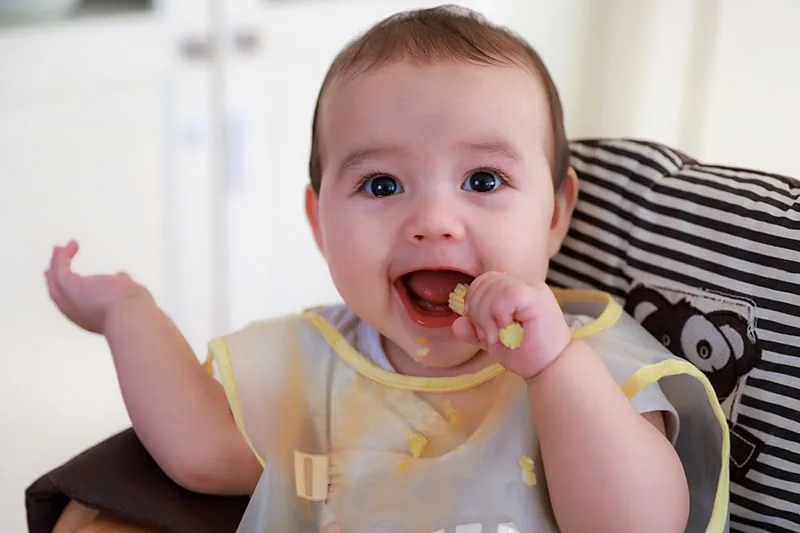
A strip of steamed sweet potato, a high chair, and a floor you have accepted will need mopping.
Baby-led weaning means offering soft, finger-sized pieces of food from around six months and letting your baby feed herself instead of being spoon-fed purée. Start once she sits steadily and brings things to her mouth. Keep her upright, keep milk feeds going, and put an iron-rich food on the tray every day.
What is baby-led weaning?
The idea is simple. Food arrives in pieces your baby can hold, and she decides what goes in her mouth, how fast, and when she has finished.
The NHS describes finger foods as suitable from the very start of solids, alongside mashed and puréed food, so this is now one normal option among several. Babies who feed themselves practise their grip, learn how wide to open their mouths, and get used to stopping when they are full. They also get to touch everything, which is how a baby learns what a food is.
There are real costs. More mess, slower meals at first, and less certainty about how much went in. Some families love it. Some find it stressful and go back to a spoon, and that is a reasonable call.
When is a baby ready to start?
Around six months, which is the guidance from the World Health Organization and KKM, with breastfeeding or formula carrying on alongside. Before then, a baby's swallow and gut are not ready for solid food.
The NHS lists the signs of readiness. She can stay sitting with a steady head, can look at food, pick it up and get it to her mouth, and swallows food rather than pushing it back out. You want all of these, not just one.
Feeding herself asks a little more than spoon feeding. She needs enough control of her body to sit upright without slumping sideways, because a slumped baby cannot protect her own airway. If she still needs propping up, start with a spoon and try finger food again in a few weeks.
How do you cut and serve food safely?
This section matters most. Everything else about baby-led weaning is preference.
- Cut pieces about the length and width of your own index finger, so her fist can hold one with an end sticking out
- Cook anything firm until it squashes under gentle pressure between your finger and thumb
- Quarter grapes and cherry tomatoes lengthways, and take the seeds out of longan, lychee, rambutan and duku
- Leave out whole nuts, popcorn, raw apple and carrot sticks, hard sweets, keropok, and chunks of sticky dried fruit
- Thin peanut butter with water or milk before spreading it
- Seat her upright in a high chair with her feet supported, facing forward
- Never feed her in a car seat, a stroller, a carrier or lying back
- Stay at the table the whole time, and eat with her when you can
Two more habits help. Try one new food at a time, with a few days before the next, so you can tell what caused a reaction. And keep screens away, since a baby watching a phone is a baby who has stopped paying attention to her mouth.
The American Academy of Pediatrics now advises giving the common allergenic foods early rather than holding them back. Egg, peanut, dairy, wheat, soy, fish and shellfish all belong in these first months. If your baby has severe eczema or a known food allergy, ask your doctor before giving peanut and egg. Hives, swelling, vomiting or wheezing after a food mean stop and get medical advice the same day, and any trouble breathing means calling 999.
How do you tell gagging from choking?
Listen. A gagging baby is loud, red in the face and plainly annoyed. Her gag reflex is doing its job, pushing food forward and out. It sits further forward in her mouth than yours, so it triggers easily and often.
A choking baby makes no sound at all. No cough, no cry, no air moving. She may go quiet, floppy or blue around the lips.
Coughing and spluttering mean let her finish clearing it while you stay close. Silence means act. Learn infant back blows and chest thrusts before her first meal, and keep your phone within reach, because the emergency number is 999.
Where does the iron come from?
The iron stores your baby built up in pregnancy start running low at around six months, which is a large part of why solids start then. A tray of fruit and plain rice will not cover it.
Offer something iron-rich every day, in a shape she can grip. Soft minced chicken or beef pressed into a finger shape, flaked fish such as ikan kembung with the bones removed, egg, dhal thick enough to hold its shape, tofu, or iron-fortified infant cereal on a spoon she holds herself. Vitamin C helps her absorb iron from plants, so a few pieces of papaya, mango or orange at the same meal do double duty.
Milk is still most of her nutrition for months. The World Health Organization recommends breastfeeding alongside solid food up to two years and beyond. A baby who suddenly drops several feeds while barely eating needs a check at the klinik kesihatan.
Can you mix spoon feeding and self-feeding?
Yes, and most Malaysian families end up doing exactly that. A loaded spoon of bubur at breakfast because you are rushing out, a strip of steamed pear in the evening when there is time to let her play with it.
Nothing is lost by mixing. A baby learns texture from lumps and purée as well as from finger food, and the goal in the first year is a wide range of flavours and textures rather than loyalty to one method. Your confinement lady, your mother and your mother-in-law may each have firm views. A mixed approach is allowed.
Suction tableware helps a lot at this stage, because a bowl that ends up on the floor is lunch lost. Our Jolly Feeding Set has a silicone bowl and plate that hold on with suction, cutlery sized for small hands, a sippy lid and a deep bib that catches what falls. It comes as a gift set in teal, turquoise or pink, so it also makes a lovely present for a friend about to start solids.
Teething can put a self-feeder off firm pieces for a week. Softer shapes and something cold to chew help, and a teether is sometimes more welcome than lunch. If your baby is fussy with new foods, our guide to picky eating in babies has ideas.
What does this look like in a Malaysian kitchen?
Steam, mash, serve. A steamer basket over any pot handles sweet potato, pumpkin, broccoli with the stalk left as a handle, pear and carrot in under ten minutes, and the pasar will happily sell you a single sweet potato.
Family food works better than separate baby food once you cook with your baby in mind. Leave out the salt, stock cube, kicap, sambal and chilli until her portion is lifted off, then season the rest for everyone else. Nasi lemak, soup noodles, seasoned bubur from a stall and most gravies carry more salt than a baby's kidneys can handle, and the NHS is clear about avoiding salty food in the first year. Honey is off the menu until she is one.
Heat changes appetite too. Many babies eat less on a sticky afternoon and drink more, and a few pieces of watermelon may be the whole meal some days. Offer water in an open cup with meals from six months, and expect most of it down her front.
When should you ask for help?
Some feeding problems need a professional rather than a forum. Ask if your baby coughs or splutters on liquids every time, arches and screams at the sight of food, is losing weight or has flattened off on her growth chart, or still cannot manage any lumpy texture by nine or ten months.
The klinik kesihatan is the way in. The doctors there can refer you on to dietitians, allergy clinics and feeding specialists at the hospital.
Book an infant first-aid class before you start, not after a scare. St John Ambulance Malaysia, the Malaysian Red Crescent and private training providers run short courses on back blows and chest thrusts for babies, and an hour of practice on a training doll is worth more than every safe-shape rule on this page.
Frequently asked questions
- Is baby-led weaning safer or riskier than spoon feeding?
- Either way of feeding works well when the food is the right texture and your baby is sitting upright, and either becomes risky with hard, round pieces or a baby lying back in a stroller. How the food is shaped and how your baby sits matter far more than who holds the food.
- How soft does a finger food need to be?
- Soft enough to squash against the roof of your mouth with your tongue, or between your finger and thumb with gentle pressure. Steamed carrot that still snaps is too firm. Cut pieces about the length of your index finger so your baby can hold one and bite the end.
- My baby gags at nearly every meal. Is she choking?
- Gagging is loud, red-faced and protective, and it moves food back to the front of the mouth. Choking is silent, because no air is moving. Noise and coughing mean let her carry on while you watch. Silence, blue lips or floppiness mean act at once and call 999.
- Will my baby get enough iron if she feeds herself?
- Only if iron-rich food is on the tray. Iron stores run low at around six months, so offer soft meat, flaked fish, egg, dhal, tofu or iron-fortified cereal every day, in shapes she can pick up. Fruit and plain rice will not cover it.
- Can I give my baby food from a kedai makan?
- Take the plain parts. White rice, plain porridge, steamed fish or an unsauced vegetable are fine. The salt, stock, kicap, sambal and gravy are the problem, because they carry more salt than a baby's kidneys can handle in the first year.
Sources
- NHS: Your baby's first solid foods
- WHO: Infant and young child feeding
- American Academy of Pediatrics (HealthyChildren): Starting solid foods, choking prevention and allergenic foods
- myHEALTH (Kementerian Kesihatan Malaysia): Complementary feeding for babies
- Malaysian Dietary Guidelines for Children and Adolescents (Kementerian Kesihatan Malaysia)
Share this article
This article is for information only and is not a substitute for diagnosis or medical advice. Please talk to your doctor about your own situation.